Shopping for a new vacuum cleaner often feels like taking an unexpected crash course in mechanical engineering. Product packaging is plastered with competing technical jargon, boasting about motor wattage, sealed lift, airflow ratings, and dynamic pressure stats. When you are just trying to find a reliable machine for routine house cleaning or heavy-duty deep cleaning, deciphering numbers like 20 kPa or 180 AW can get frustrating very quickly. Understanding how these specs translate to real-world performance on tile, hardwood, and thick carpeting is the key to spending your money wisely.
Quick answer: Kilopascals (kPa) measure a vacuum's sealed suction or pulling force, indicating how well it can lift dense debris or dig into deep carpet fibers. Air Watts (AW) measure overall cleaning efficiency by calculating the combination of suction pressure and airflow (CFM). For effective home maintenance, look for a vacuum that balances both specs rather than relying on motor wattage alone.
Demystifying the Technical Specs: What kPa and AW Actually Measure
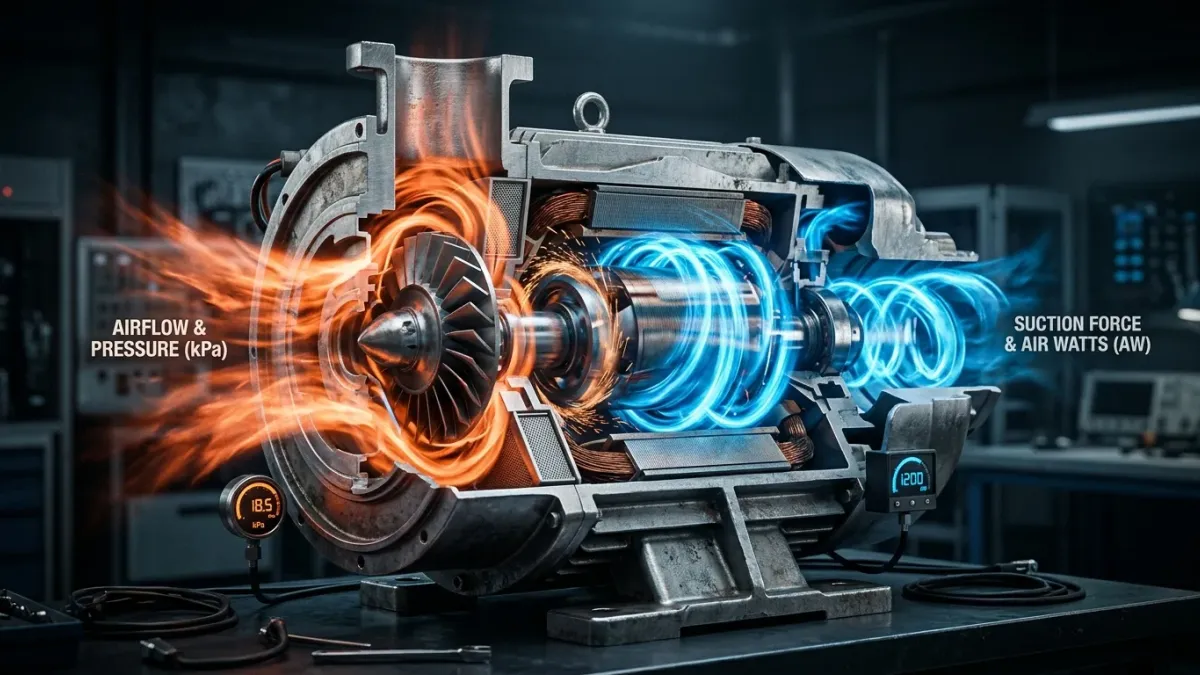
To evaluate a machine's cleaning capability, you must first look at Kilopascals (kPa), which measure static suction pressure. Imagine placing your palm completely over the end of a vacuum hose so no air can enter; the pull you feel against your skin is static lift, measured internationally in kilopascals or inches of water lift. A high kPa rating means the motor creates a powerful vacuum seal capable of pulling dense particles like sand, cat litter, or crushed cereal out of tight crevices. Handheld stick vacuums usually start around 12 to 15 kPa, whereas commercial canister units and high-end uprights frequently reach 24 to 30 kPa.
Air Watts (AW), on the other hand, represent the actual unit of output power rather than just sealed force. Formulated by ASTM International (specifically standard F558), Air Watts calculate the relationship between airflow in cubic feet per minute (CFM) and water lift suction. A machine can have massive static suction, but if it cannot move a high volume of air through its filters and dustbin, it won't sweep up surface dust efficiently over a broad pass. Cordless models like the Dyson V15 boast around 230 AW in boost mode, whereas heavy-duty corded uprights from brands like Shark or Bissell consistently deliver 200 to 300+ AW of sustained pulling power.
It is equally crucial not to confuse motor input wattage with suction performance. A vacuum labelled as having a "1200-Watt Motor" simply tells you how much electrical power the unit draws from your wall outlet, not how efficiently it converts that electricity into pulling force. Inefficient motor design, poor internal sealing, and restricted filter pathways can waste hundreds of watts as raw heat. Always prioritize AW and kPa over raw motor wattage when upgrading your personal inventory of vacuum and floor cleaners.
Cleaner's tip: Never judge a vacuum's power solely by how hard the floor head seals against a flat surface. During residential deep cleaning sessions, I routinely see clients burn out drive belts or overheat motors because they set their vacuum height too low, creating a complete suction seal that chokes off airflow. If your vacuum lacks proper airflow, fine dirt stays trapped in the rug base no matter how high the kPa rating is.
Comparing kPa and Air Watts across Vacuum Categories
Different cleaning tasks require distinct balances of suction pressure and airflow. Understanding where popular vacuum categories fall on the performance spectrum helps you set realistic expectations before purchasing equipment for your domestic routine or professional cleaning services.
| Vacuum Type | Average kPa Range | Average Air Watts (AW) | Best Suited For |
|---|---|---|---|
| Cordless Handheld | 8 - 14 kPa | 30 - 90 AW | Quick car detailing, spot cleaning spills |
| Cordless Stick Vacuum | 15 - 24 kPa | 100 - 230 AW | Hardwood floors, daily maintenance, low-pile rugs |
| Corded Upright Vacuum | 20 - 28 kPa | 180 - 300+ AW | Medium to high-pile carpets, pet hair extraction |
| canister vacuum | 22 - 30+ kPa | 220 - 350+ AW | Whole-house deep cleaning, stairs, delicate hard floors |
When executing precise cleaning tips and techniques on delicate hardwood, high airflow (AW) matters significantly more than raw static pressure (kPa). Hard surfaces do not require deep fiber agitation; instead, they need consistent airflow to sweep loose grit into the nozzle without scattering it across the room. Conversely, pulling stubborn pet dander and tracked-in dirt out of 85-ounce plush wool carpets demands high static suction (at least 22 kPa) paired with a mechanical brush roll.
Key Features That Affect Real-World Suction Performance
Static specs on paper do not always match real-world performance if the machine lacks supportive hardware. Suction power degrades rapidly when internal components are neglected or poorly designed, turning a high-performance machine into an ineffective tool over time.
Filtration Efficiency and HEPA Ratings
Air must pass directly through filters before exiting the exhaust port, making filtration design a key variable in sustained suction. Standard foam or fabric filters clog quickly with fine micro-particles, causing an immediate drop in working CFM and Air Watts. High-efficiency particulate air (HEPA) filters trap 99.97% of particles down to 0.3 microns, protecting both indoor air quality and internal motor components. Multi-cyclonic separation technology—used extensively by manufacturers like Dyson and Shark—flings fine dust out of the airstream before it ever touches the primary filter, preventing premature clogging and maintaining steady performance during extended deep cleaning routines.
Nozzle Design and Mechanical Agitation
Suction alone cannot dislodge tangled debris from textiles. A motorized roller brush fitted with dense nylon bristles or rubber anti-tangle fins provides the mechanical agitation needed to loosen debris so the air stream can carry it away. For mixed flooring, select floor heads with adjustable gates. Opening the front gates allows larger debris (like dry cereal or dog kibble) to pass under the head without breaking the vacuum seal needed to maintain lift across tile grout lines.
Hose Diameter and Seals
Physics dictates that air velocity increases as pipe diameter decreases, but volume decreases simultaneously. Narrow 1.25-inch hoses generate impressive localized pressure, ideal for detail tools, but restrict total airflow. Standard residential uprights utilize 1.5-inch to 2-inch internal air paths to maximize CFM. Furthermore, minor leaks around rubber gaskets, dustbin seals, or quick-release wand joints act as pressure bleeds, reducing a vacuum's effective end-of-wand kPa rating by as much as 30%.
Matching Vacuum Specifications to Your Home's Needs
Every home presents unique challenges, from shedding long-haired pets to dense plush carpeting or extensive slate and oak flooring. Selecting the correct specifications ensures you complete your routine house cleaning efficiently without overspending on commercial-grade machinery you do not need.
For homes dominated by hard floors, engineered laminate, or tight low-pile commercial carpet, focus your search on machines delivering between 120 and 150 Air Watts. High static kPa is unnecessary here because there are no deep carpet fibers to penetrate. Ensure the unit features a dedicated soft-roller floor head or a brush-roll shut-off switch to prevent scratching delicate polyurethane wood finishes.
If your residence features multi-story layouts, medium-to-high pile rugs, or multiple shedding pets, step up to a unit offering at least 22 kPa of static lift and 200+ Air Watts. Pets introduce dander and fine oily hair that cling to textile backing; extracting these allergens requires sustained suction power combined with sealed HEPA filtration to keep ambient air clean and safe for allergy sufferers.
Maintaining high performance over the lifetime of your appliance requires continuous preventative maintenance. Empty rigid dust bins when they reach the fill line, wash primary foam filters monthly in lukewarm water without soap, and check the brush roller weekly for tangled hair. Inspect rubber seals for cracking, and clean fine dust out of cyclone assemblies every six months to keep your machine pulling at its factory-rated kPa and AW specs for years to come.
Frequently Asked Questions
Is higher kPa always better for vacuuming hard floors?
No, excessively high kPa is not necessary for hard floors and can sometimes make the vacuum head seal so tightly against smooth surfaces that it becomes difficult to maneuver. For tile, vinyl, and wood, high airflow (CFM/Air Watts) paired with a soft brush roll is far more effective than maximum static suction.
Why does my vacuum lose suction even though it has a high AW rating?
A high Air Watts rating indicates peak potential under ideal conditions. In practice, suction drops when the dustbin is full, filters are clogged with fine dust, the brush roll is tangled with hair, or small cracks form in the flexible hose gaskets. Regular maintenance restores original performance levels.
Can a cordless vacuum really match the suction power of a corded unit?
Modern high-end cordless vacuums can match or exceed the suction of mid-range corded units in short bursts (Boost or Turbo mode). However, running at maximum AW rapidly drains battery life—often in under 10 minutes—whereas corded vacuums maintain continuous peak power without performance throttling during long cleaning sessions.
To optimize your daily routine and protect your home investment, match your specific flooring types and household mess levels directly to the right balance of specs: choose high CFM and Air Watts for hard surfaces and broad floor coverage, or prioritize high kPa static lift combined with a motorized brush roll for deep pile carpets and tough pet hair extraction.
Sources
- ASTM International - Standard Test Method for Measuring Air Performance Characteristics of Vacuum Cleaners (F558)
- US EPA - Indoor Air Quality and Floor Maintenance Guidelines
- Wikipedia - Vacuum Cleaner Design and Performance Specifications