
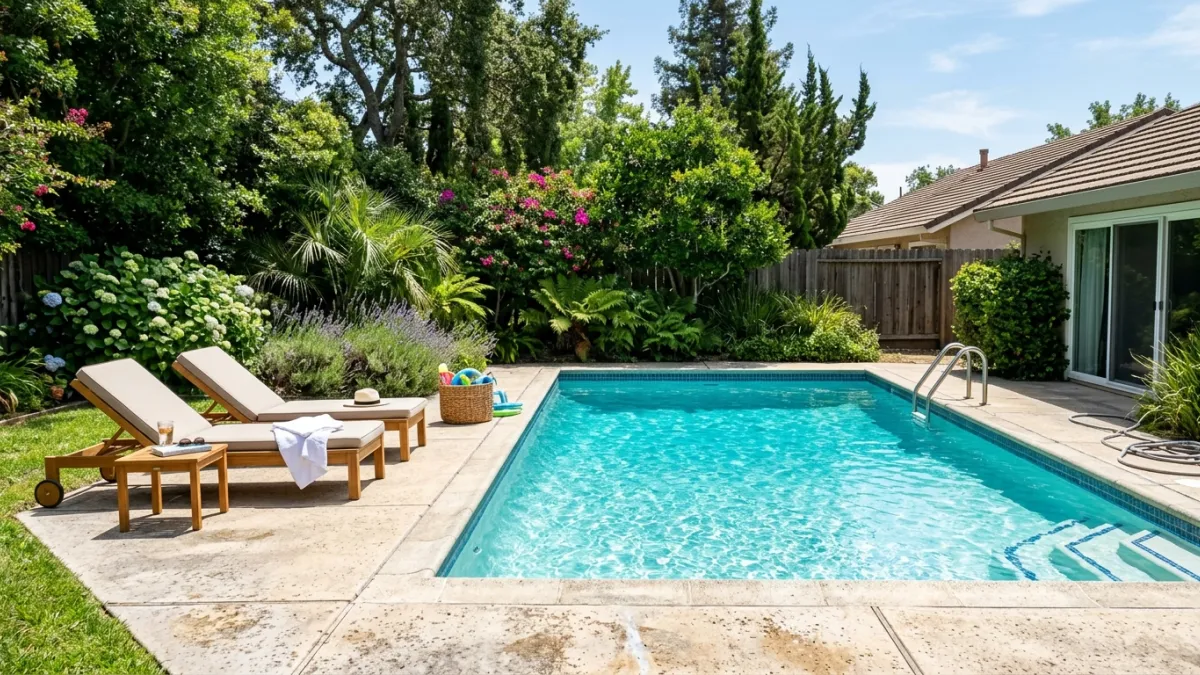
Stepping out to your backyard pool only to find cloudy green water, slimy yellow dust along the steps, or stubborn black spots creeping across the plaster is a nightmare for any homeowner. Algae blooms can take over an outdoor pool in less than 24 hours during peak summer heat. While all pool algae thrives on sunshine, warm water, and poor circulation, treating every type with the exact same method usually results in wasted money and persistent blooms. Successful pool care requires knowing precisely which organism has invaded your water and adjusting your scrubbing technique, chemical dosage, and filtration routine accordingly.
Quick answer: Green algae floats suspended in water and succumbs quickly to standard chlorine shock, whereas mustard algae forms a yellow, powdery layer in shaded spots that resists normal chlorine levels. Black algae is actually a deep-rooted cyanobacteria that embeds itself inside porous plaster or grout, requiring a stainless steel brush and triple-strength chlorine shocking to eradicate completely.
Identifying the Three Major Types of Pool Algae
Before throwing pounds of chemical shock into your pool, you must correctly identify the invader. Green algae (Chlorophyta) is the most frequent unwanted guest. It begins by making the water look slightly hazy or pale green before evolving into a thick, pea-soup swamp. It floats freely in the water column and coats pool walls with a slippery, greenish slime that brushes away effortlessly. Because green algae lacks a heavy defense mechanism, it reacts quickly to standard chemical treatments when water balance is maintained properly.
Mustard algae (often called yellow algae) presents a trickier diagnostic challenge. It resembles fine sand, pollen, or mustard powder resting on the pool floor, inside light niches, or along shaded steps. When brushed, it disperses into a cloud and vanishes momentarily, only to settle back in the exact same spot within 12 to 24 hours. Unlike green algae, mustard algae clings to surfaces rather than clouding the entire body of water, and it carries a protective outer sheath that allows it to survive standard chlorine concentrations of 1.0 to 3.0 parts per million (ppm).
Black algae is the most destructive and aggressive form of infestation. Scientifically classified as cyanobacteria, it forms dark blue-green or black spots ranging from pinhead size to a nickel. It does not float. Instead, it roots itself deep into porous surfaces like gunite, plaster, concrete, and tile grout. It secretes a protective waxy biofilm cap over its surface that blocks normal chlorine penetration, making simple brushing or light shocking completely ineffective.
| Algae Type | Appearance & Behavior | Chlorine Resistance | Primary Target Surface |
|---|---|---|---|
| Green Algae | Cloudy green water, slippery wall slime, floats freely | Low (Killed at 10-12 ppm Free Chlorine) | Water column, all liner types |
| Mustard Algae | Yellowish-brown powder, settles in shade, poofs away when brushed | Moderate-High (Requires 15-20 ppm Free Chlorine) | Shaded walls, step treads, light niches |
| Black Algae | Dark raised spots, rough texture, embedded root structure | Extreme (Requires 20-30 ppm FC + manual abrasion) | Porous plaster, pebble-tec, grout lines |
Chemical Chemistry: pH, CYA, and Chlorine Shock Levels
To eliminate any algae strain, water chemistry must be adjusted before adding sanitizer. Shocking a pool with improper pH or excessive Cyanuric Acid (CYA) wastes chemicals. Chlorine is most effective when pH is adjusted to a slightly acidic range between 7.2 and 7.4. At a high pH of 7.8, liquid chlorine loses roughly 50% of its oxidizing power, allowing algae cells to survive the shock cycle.
Cyanuric acid acts as a sunscreen for chlorine, protecting it from ultraviolet degradation. However, when CYA levels exceed 50 ppm, a condition known as "chlorine lock" occurs, binding free chlorine and rendering it unable to kill pathogens. For effective deep cleaning, CYA should sit between 30 and 40 ppm. Liquid pool shock (12.5% sodium hypochlorite) is preferred over granular dichlor or trichlor shock because it raises free chlorine instantly without increasing CYA levels or building up calcium hardness.
Cleaner's tip: Homeowners often skip testing Cyanuric Acid before shocking for mustard algae. If your CYA is at 80 ppm, bringing free chlorine to a standard 10 ppm won't touch the algae. You need free chlorine at roughly 40% of your CYA level just to kill basic green algae, and up to 60% for mustard algae. Lower your CYA by partially draining the pool first, or you'll burn through chemical shock without fixing the problem.
Step-by-Step Eradication Protocol for Each Algae Type
Treating green algae requires a straightforward three-step process: test, shock, and filter. First, adjust the pH to 7.2 and Total Alkalinity to 90 ppm. Calculate the dosage of 12.5% liquid sodium hypochlorite needed to bring free chlorine to 12 ppm (roughly 1 gallon per 10,000 gallons of water). Brush all pool walls with a standard nylon wall brush, then run your filtration system continuously for 24 to 48 hours. If using a sand filter, backwash when pressure increases by 8 PSI; if using a cartridge filter, rinse with a high-pressure hose nozzle once the flow drops.
Eliminating mustard algae demands higher chemical intensity and strict sanitation of surrounding gear. Because mustard algae spores travel easily on swimsuits, maintenance tools, and inflatable toys, place all brushes, hoses, and vacuum heads directly into the shallow end before shocking. Scrub every inch of the pool using a heavy-duty brush. Elevate free chlorine to 15-20 ppm using liquid shock and maintain this level for a contact dwell time of at least 72 hours. Adding a specialized polyquat 60 algaecide after shocking helps break down the algae's protective sheath.
Black algae removal is physical combat that requires specialized tools. Standard nylon brushes cannot break the hard, waxy shell covering black algae spots. Plaster, gunite, and concrete pools require a stiff stainless steel wire brush to scrape off the protective layer and expose the underlying root matrix. Vinyl and fiberglass pools require a high-density stainless-nylon hybrid brush to prevent liner tears. After scrubbing vigorously, rub a split 3-inch Trichlor chlorine tablet directly over visible dark spots to deliver concentrated sanitizer. Superchlorinate the water to 20–30 ppm free chlorine, run the pump 24/7, and re-brush spots twice daily until all roots dissolve completely.
- Nylon Bristle Brushes: Safe for vinyl, fiberglass, and painted pool surfaces; ideal for sweeping green and mustard algae.
- Stainless Steel Wire Brushes: Mandatory for hard plaster, gunite, and pebble surfaces to cut through black algae caps.
- Polyquat 60 Algaecide: Non-foaming, non-staining liquid algaecide that assists in breaking down stubborn cellular structures.
- Liquid Chlorine (Sodium Hypochlorite 12.5%): Fast-acting liquid oxidizer that leaves zero CYA residue.
Filter Maintenance and Long-Term Prevention Routines
Killing algae inside the pool is only half the battle; capturing microscopic dead spores inside the filtration system prevents secondary outbreaks. After shocking, vacuum dead algae debris directly to the "Waste" setting on multi-port sand filter valves. Vacuuming directly to waste bypasses the filter medium, preventing fine algae dust from blowing back into the pool through return jets. For cartridge filters without a waste option, remove the cartridge element, spray it thoroughly with a cartridge cleaner solution, and allow it to soak for 12 hours to dissolve trapped organic fats.
Long-term prevention relies on consistent mechanical circulation, proper chemical balance, and routine hygiene. Maintain pump run times of 8 to 12 hours daily during warm months to eliminate dead circulation zones where algae spores establish roots. Aim for a minimum continuous free chlorine reading of 2.0 to 4.0 ppm. Regularly test phosphate levels with a professional water testing kit; phosphates act as the primary food source for all algae species, and levels should be kept below 100 parts per billion (ppb) using a lanthanum-based phosphate remover.
Home maintenance schedules should also incorporate regular deep cleaning of skimmer baskets, pump strainer pots, and automatic pool cleaners. Washing swimsuits in hot water and washing pool accessories with a mild eco-friendly cleaner before returning them to the pool eliminates cross-contamination from natural lakes or neighborhood pools. Combining disciplined pool care routines with proper chemical monitoring ensures your outdoor living space stays sparkling clean and safe for family swimming all season long.
If your pool water remains stubbornly cloudy after treating an infestation, or if black algae spots refuse to lift after multiple scrub cycles, consult a certified pool operator or professional cleaning services. Start your treatment plan by running a complete water test to check pH, Total Alkalinity, and CYA levels today, then grab the correct brush type for your pool lining to prepare surfaces for superchlorination.
Frequently Asked Questions
Can I swim in the pool while treating algae?
No, you should not swim while treating an active algae bloom. Elevated shock levels of free chlorine (above 5.0 ppm) can cause skin irritation, eye burns, and damage to swimwear, while active algae blooms can harbor harmful bacteria. Wait until free chlorine drops back to safe levels (1.0–4.0 ppm) and the water is crystal clear.
Why does mustard algae keep coming back after I shock the pool?
Mustard algae returns when chlorine levels are not held high enough for a sufficient dwell time, or because contaminated items reinfected the water. Swimsuits, pool toys, vacuum hoses, and brushes must all be sanitized in shock-level pool water during treatment, and free chlorine must be maintained at 15–20 ppm for at least 72 hours to kill the spores.
Will chlorine tablets alone get rid of black algae?
Chlorine tablets alone will not eliminate black algae because the bacteria forms a protective waxy layer over its root system. You must scrub the spots vigorously with a stainless steel brush to break open the outer cap before rubbing a trichlor tablet over the area and superchlorinating the water.
Sources
- US Environmental Protection Agency (EPA) - Water Disinfection Guidance
- Centers for Disease Control and Prevention (CDC) - Healthy Swimming & Aquatic Venues
- Wikipedia - Cyanobacteria (Black Algae Overview)
Looking for the Right Supplies?
Check out our verified Top Cleaning Products & Tools on Amazon.
As an Amazon Associate, we earn from qualifying purchases.