
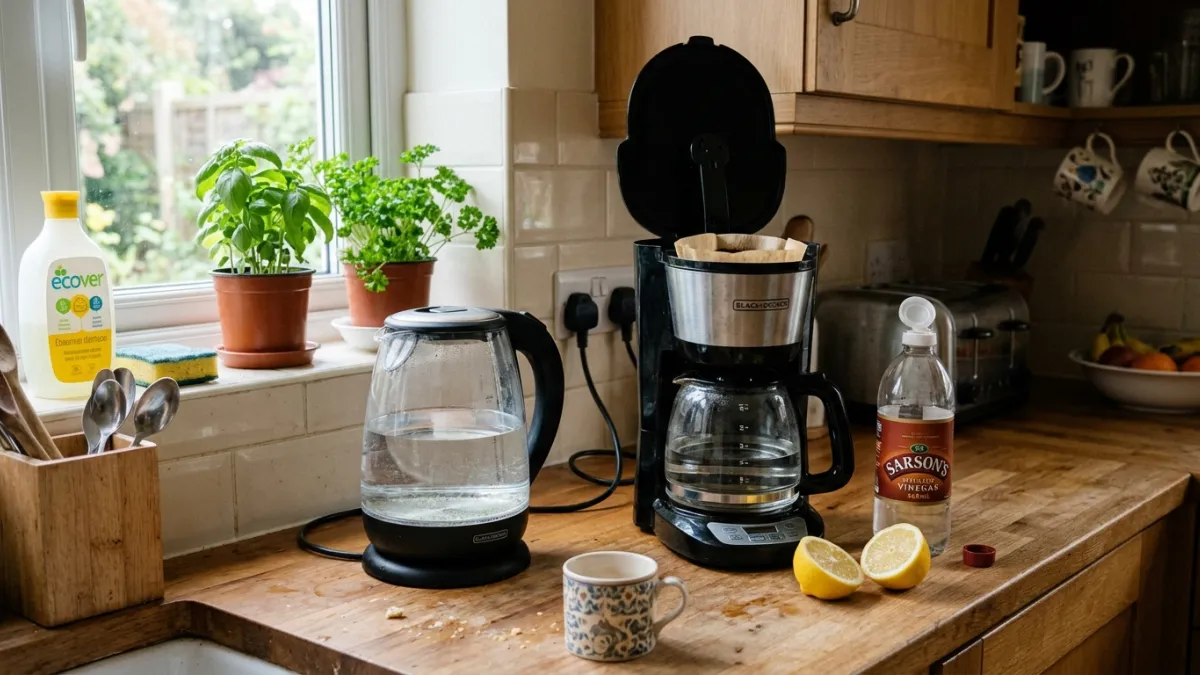
Quick answer: Descaling requires an acidic solution—such as equal parts white vinegar and water or 2 tablespoons of citric acid per liter—to dissolve hard calcium carbonate deposits in 15 to 30 minutes. Running a full heating cycle followed by two thorough freshwater rinses removes scale buildup and eliminates residual taste without damaging internal seals.
Understanding Limescale and Why Standard Washing Fails
Limescale consists primarily of calcium carbonate ($CaCO_3$) along with trace magnesium ions left behind as water evaporates or boils. Standard dish soap and neutral multi-purpose cleaners, which typically operate around pH 7.0 to 8.0, are formulated to lift oils and organic grime. They cannot break the ionic bonds holding mineral scale to stainless steel, copper, or silicone heating pathways. To dissolve calcium carbonate efficiently, you must introduce a mild, food-safe acid with a pH between 2.0 and 3.0, which converts the insoluble carbonate into soluble calcium salts and carbon dioxide gas. Ignoring mineral buildup affects both energy consumption and liquid temperature regulation. A mere 1-millimeter layer of limescale on an electric kettle heating plate can increase energy consumption by up to 7% because scale conducts heat at a fraction of the rate of stainless steel. In espresso machines and single-serve pod systems like Keurig or Nespresso units, narrow 2-millimeter internal water lines become restricted. This restriction drops flow rates, reduces extraction temperature from the ideal $195^\circ\text{F}–205^\circ\text{F}$ range down to tepid levels, and creates excessive backpressure that ruins pump impellers. When selecting a descaling strategy, homeowners usually choose between natural household acids and commercial sulfamic or lactic acid formulations. While white household vinegar (5% acetic acid concentration) is readily available, citric acid powder (100% anhydrous) and commercial descalers like Dezcal or Urnex liquid offer distinct advantages regarding speed, odor, and material compatibility.| Descaling Agent | Active Acid Concentration | Average Working pH | Odor Level | Best Appliance Application |
|---|---|---|---|---|
| White Distilled Vinegar | 5% Acetic Acid | 2.4 – 2.6 | Pungent / Strong | Standard Electric Kettles & Glass Pitchers |
| Citric Acid Powder | 100% Anhydrous Food Grade | 2.1 – 2.3 | Odorless | Drip Coffee Makers & Single-Serve Pod Brewers |
| Commercial Descaler (Dezcal/Urnex) | Sulfamic / Lactic Acid Mix | 1.5 – 2.0 | Neutral / Mild | Espresso Machines & High-End Thermal Brewers |
How to Descale an Electric or Stovetop Kettle Step-by-Step
Descaling a kettle is straightforward because the heating element or bottom plate is directly accessible inside the boiling chamber. For moderate chalky buildup, household white vinegar works well, but for deep cleaning heavily encrusted kettles, a citric acid solution reacts faster and leaves zero lingering odor. Start by unplugging electric bases or taking stovetop kettles off the burner to ensure safety while inspecting the interior lining. If using white vinegar, fill the kettle with a 1:1 mixture of water and 5% acetic acid white vinegar, ensuring the liquid covers all visible white scale spots. Bring the solution to a boil, turn off the power, and let it sit for at least 20 to 30 minutes. For citric acid, add 2 tablespoons (approx. 30 grams) of food-grade citric acid powder to 1 liter of warm water directly in the kettle, stir until fully dissolved, and heat the water until it just begins to simmer.Cleaner's tip: Never scrub stainless steel kettle bases with steel wool or coarse green scouring pads. These create microscopic scratches on the polished metal floor, which accelerates future limescale adhesion and provides crevices for mineral buildup to lock into. Stick to non-scratch 300 GSM microfiber cloths or soft nylon bottle brushes after the acid dwell time has dissolved the mineral bonds.
Once the dwell time expires, pour the acidic solution out down the sink. Rinse the kettle interior thoroughly with cool tap water three times. To guarantee zero taste transfer to your next cup of tea, fill the kettle to its maximum fill line with plain freshwater, boil it completely, and discard the water. Wipe down the exterior with a damp microfiber cloth to remove any stray drips that could tarnish the exterior finish.Deep Cleaning Drip Coffee Makers and Single-Serve Pod Machines
Coffee makers require a slightly different approach than kettles because the cleaning solution must travel through internal heating tubes, check valves, and needle jets. Using straight vinegar in advanced espresso setups or pod machines can sometimes degrade internal rubber gaskets over prolonged exposure. Citric acid powder or specialty commercial descaling liquids are ideal here because they strip scale cleanly without breaking down soft seals. For standard drip coffee makers (such as Mr. Coffee, Cuisinart, or Ninja models), prepare a solution of 2 tablespoons of citric acid dissolved in 4 cups of lukewarm water (or a 1:2 vinegar-to-water ratio for standard machines). Pour the liquid into the water reservoir. Place an empty paper filter in the basket to catch dislodged mineral flakes, position the carafe on the warming plate, and start a standard brew cycle. Halfway through the brewing process, pause the machine for 15 minutes to allow the hot acid to sit directly inside the internal boiler chamber. Single-serve pod machines require a slightly modified procedure to ensure the needle assembly and check valves clear properly:- Remove any water filters (such as active carbon pouches) from the water reservoir before introducing descaling solutions.
- Empty the capsule collection bin and drip tray, then fill the reservoir with your prepared citric acid solution or commercial descaler mixture.
- Place a large ceramic mug on the drip tray, lift and close the pod handle without inserting a pod, and run continuous large-cup brew cycles until the add-water indicator flashes.
- Let the machine rest for 20 minutes to dissolve internal scale inside the narrow heating lines.
- Rinse the water reservoir thoroughly, fill it to capacity with clean water, and run at least three to four full cycles of fresh water through the machine to flush away all trace acidity.
Preventative Maintenance Routines and Safe Cleaning Practices
Establishing a routine home maintenance schedule keeps mineral deposits from forming thick crusts that require aggressive chemical treatment. If your home has hard water—typically defined as water containing over 120 parts per million (ppm) or 7 grains per gallon of dissolved minerals—you should descale your kettle and coffee maker every 30 to 45 days. Homes with soft water can safely extend this interval to every 60 to 90 days. Integrating simple preventative habits saves substantial deep cleaning time later. Never leave leftover water standing in your kettle or coffee reservoir overnight, as stagnant cooling water accelerates mineral precipitation onto metal surfaces. Using filtered pitcher water or an under-sink reverse osmosis system drastically reduces the volume of calcium carbonate entering your appliances, shifting your descaling schedule from a monthly chore to a quarterly touch-up. Safety is equally crucial during house cleaning tasks involving acidic solutions and thermal appliances. Always allow machines to cool slightly before pouring cold water into hot glass carafes or stainless steel bases to prevent thermal shock cracking. When using commercial descaling agents, check the product's Safety Data Sheet (SDS) and ensure you never mix acidic descaling agents with chlorine bleach or alkaline cleaners, which can generate harmful chemical fumes. For best results, kick off your maintenance by assessing your home's water hardness level and inspecting your kettle base today. If you notice a thin white veil forming across the metal bottom, skip harsh abrasive scrubbing and reach for food-grade citric acid; running a single 20-minute soak now will restore heating efficiency, protect internal components, and ensure your morning coffee tastes exactly as intended.Frequently Asked Questions
Can I use lemon juice instead of white vinegar to descale my kettle?
Yes, fresh or bottled lemon juice works well because it contains natural citric acid with a pH of roughly 2.0. Mix equal parts lemon juice and water, bring it to a boil in the kettle, let it soak for 20 minutes, and rinse thoroughly. It leaves a pleasant fresh scent rather than the pungent aroma of vinegar.
Why does my coffee still taste like vinegar after descaling?
A lingering vinegar taste indicates that the appliance was not flushed with enough fresh water after descaling. Run at least two to three full brew cycles using fresh, plain water through drip coffee makers, or boil and discard two full pots of water in a kettle before brewing your next beverage.
Is citric acid safe for all coffee makers and pod machines?
Citric acid is safe, effective, and odorless for almost all coffee makers, including pod-style machines like Keurig and Nespresso. However, always review your specific manufacturer owner manual first, as a few high-end commercial espresso machines specify proprietary lactic acid formulas to preserve specialized internal brass or nickel platings.
Sources
- U.S. Geological Survey (USGS) - Hardness of Water Guidance
- U.S. Environmental Protection Agency (EPA) - Drinking Water Standards
- Wikipedia - Limescale Properties and Chemical Reactions
Looking for the Right Supplies?
Check out our verified Top Cleaning Products & Tools on Amazon.
As an Amazon Associate, we earn from qualifying purchases.